Tendon Hand
Each finger of the Pioneer hand is driven by four motors in the forearm, one cable each. The cables are named by their job, f1–f4, the same on every finger. f1 is the spread cable: it pulls the finger's spread yoke toward the thumb, and a spring pulls it back. A closed cross-cable between the PIP and DIP knuckles makes the last two joints bend together.
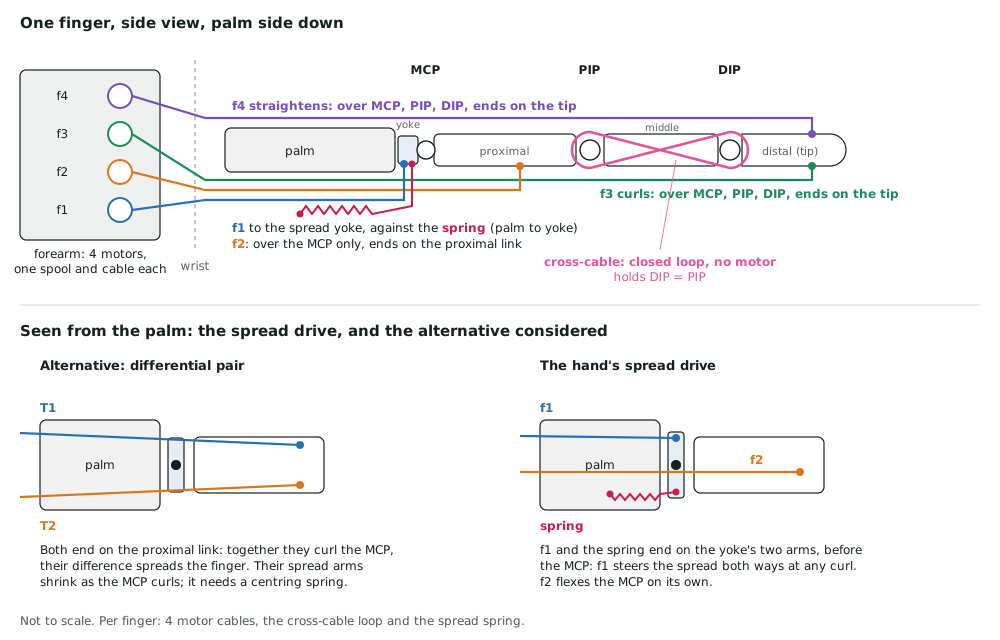
Top: one finger from the side, palm side down. Bottom: the spread drive seen from the palm, beside the alternative that was considered and not chosen (a differential pair, whose spread weakens as the finger curls). Not to scale.
| Part | Runs | Ends on | Job |
|---|---|---|---|
| f1 | palm side, thumb edge | spread yoke, one arm | turns the spread toward the thumb, against the spring |
| spring | pocket in the palm plate | spread yoke, other arm | pulls the spread back (18 N preload, 1.5 N/mm) |
| f2 | palm side, beside f3, over the MCP | proximal link | flexes the MCP |
| f3 | palm side, centre, over MCP, PIP, DIP | fingertip | curls the PIP and DIP |
| f4 | back, over MCP, PIP, DIP | fingertip | straightens the PIP, DIP and MCP |
| cross-cable | closed loop, PIP knuckle to DIP knuckle | no motor | holds DIP = PIP |
Per finger: 4 motor cables, the cross-cable loop and the spread spring. On the CAD the cables are named per finger (T1–T4 middle, I1–I4 index, R1–R4 ring, L1–L4 little).
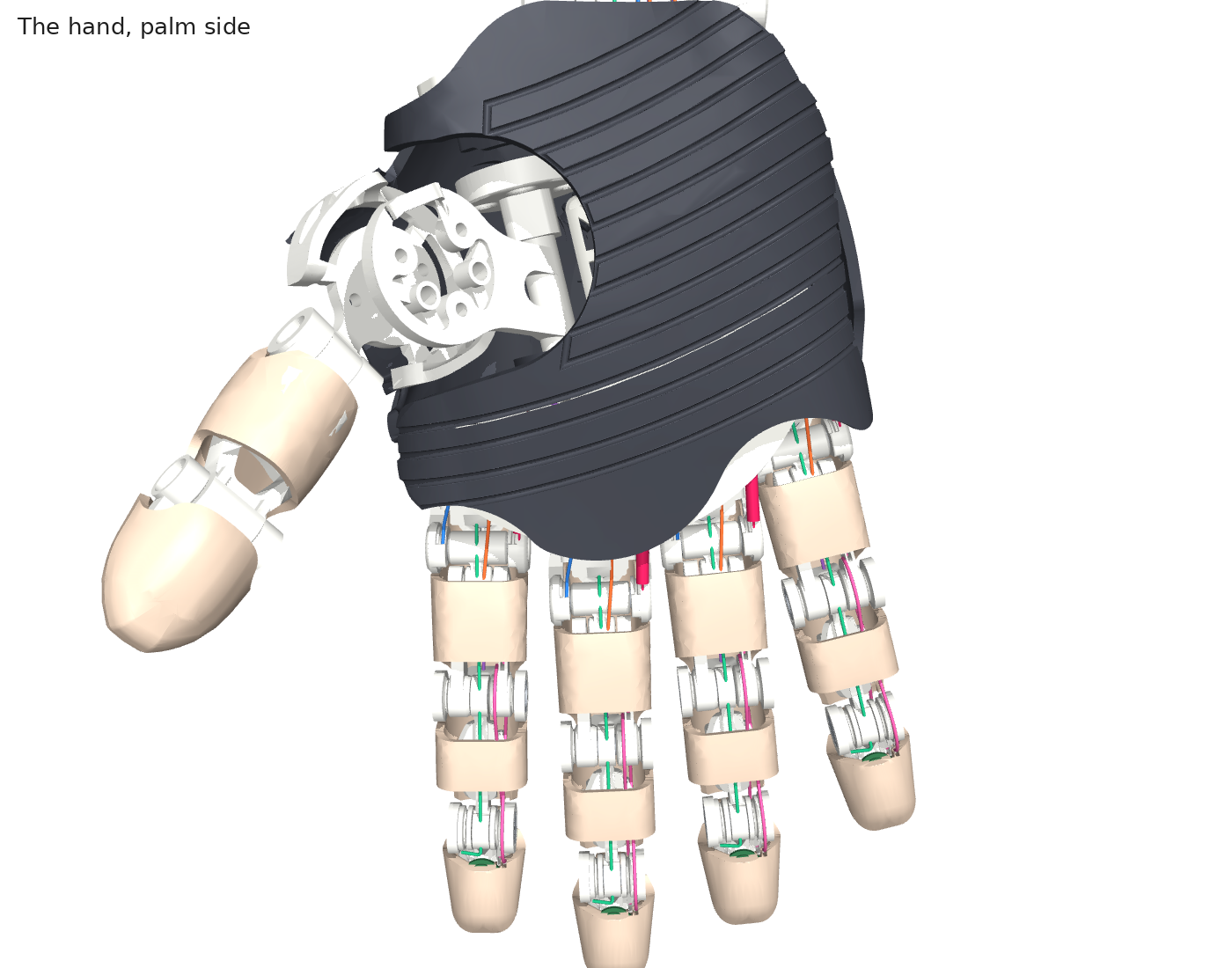
The hand from the palm side: skin, skeleton and the dark palm casing, with each cable in its own colour where it passes the knuckles. The forearm motors and the wrist are off the top of the picture; the thumb's root joints have their own motors.
Videos
These are from a MuJoCo simulation of the whole hand (all four fingers and the thumb, 20 cables), built from the CAD's own geometry. Each finger runs a joint impedance controller from its motor encoders alone: it steers toward a target angle but behaves like a spring, so it pushes on what it touches with a force you choose and gives way when pushed.
A push from behind
A probe pushes the index finger from the back, then a rod presses all four fingers. Left: the joint impedance with its torque caps and 50 N cable tension budget; the fingers give way and spring back. Right: stiff spool position servos, as on a conventional tendon hand; they fight the probe. The labels show the probe's force and the cable tensions. Why it matters: a hand that gets bumped should yield, not push back hard.
Power grasp
The fingers close softly on a 36 mm, 100 g bar and each stops at its own contact; the support drops away, the wrist swings, a 5 N pull tugs the bar, then the hand lets go. Why it matters: one "close" command holds the object without a force sensor or a planned pose per finger.
Pinch
Thumb and index in pinch mode (three times their normal stiffness) hold a 16 mm, 50 g cube; the stand drops away, then the wrist tilts ±30° and 20° sideways. The plot in the corner draws the pad force (blue) and the cube's slip against the index tip (orange) as it happens. Why it matters: precise grasps of small objects are where tendon hands usually struggle.
Tracing
The index fingertip follows a 12 mm circle. Each point of the circle is turned into MCP and PIP targets by inverse kinematics (DIP = PIP, spread 0); the controller then tracks those joint targets from the motor encoders alone, with no fingertip feedback. The trail is where it went: 1.1 mm RMS in the hand's frame. Why it matters: it shows the fingertip can be placed to about a millimetre without joint sensors.
Gestures
The hand moving through poses under the same controller: fist, counting one to five, rock, a pinch with the index and with the little finger, hook and grip.
All of this is simulation; the hand has not yet been run on hardware.