Software & Machine Learning
Bimanual Arm Inverse Kinematics
Jacobian-based iterative IK for the dual-arm setup, driving both end effectors to target poses in simulation.
6 DOF Arm + 15 DOF Hand Jacobian Iterative Based IK Controller
Inverse kinematics: fingertip_ik.py
We implemented iterative Jacobian IK with damped least squares (DLS) to take in the 5 target fingertip position and outputting the joint angle that will make it happen. It utilize the Jacobians and body positions from MuJoCo for computation, and Isaac Sim for visualization.
Algorithm
Joint Position is (where , representing the 21 DOF, specfically model.nv is the dimension of the joint velocity). Targets are world positions for the five fingertip bodies (targets dict). Only fingertip positions are constrained (jacp from mj_jacBody; jacr, the fingertip orientaton, is unused).
Iteration loop
Repeat up to max_iter times / return early if error lower than tol tolerance:
-
mj_forward(model, data)— compute forward kinematics with mujoco function -
Build error — for each fingertip that has a target, compute its error,
err = target - pos; concatenate into one vector.For fingertip :
Stacking fingertips:
-
Convergence check — if , exit early successfully.
-
Build Jacobian
J— for each such fingertip,mj_jacBody→ translation Jacobianjacp;vstackintoJ.Translation-only linearization for fingertip :
Stacking:
-
Damped least squares — solve for a joint increment
dqusing damped least squares withdamping.Compute that minimizes (formalizing the optimization problem)
The minimizer satisfies the normal equations (The actual equation that we need to solve)
-
Update —
qpos[:nv] += step * dq(i.e. ,step). -
Joint limits — if
clip_limits, runclip_to_joint_limits, enforce joint limit
Return value: new joint pos, boolean on whether it successfully converge with error under tol, max error
Defaults: damping=1e-4, step=0.5, max_iter=200, tol=1e-4, clip_limits=True.
VR Teleoperation
Meta Quest hand and wrist tracking drives both arms of the bimanual rig in real time — a browser-side WebXR page streams hand poses over a secure WebSocket to a C++ ROS 2 bridge, which feeds a per-arm damped-least-squares IK controller in Isaac Sim, with a stereo POV feed rendered back to the headset so the operator sees through the robot's own cameras. The coolest part: it isn't sim-only. A gated flag streams the left arm's live IK solution straight to the physical robot over CAN, so the same pinch-to-grip, wrist-tracked teleop that drives the simulated arm can drive the real hardware in lockstep — headset in, robot arm moving, all over a USB tunnel with no Wi-Fi setup required.
Controls
| Action | Effect |
|---|---|
| Move right / left wrist | Corresponding arm follows |
| Pinch thumb + index (either hand) | Corresponding gripper closes / opens |
R (Isaac Sim window focused) | Recalibrate — re-home both arms to current wrist pose |
--gain VALUE (default 1.0) | Scales arm motion per metre of real wrist motion |
Reinforcement Learning
In-Hand Manipulation RL Task
Reinforcement learning-based in-hand cube reorientation task for the 16 DOF Wato hand in Isaac Lab. The policy learns to reorient a DexCube held in the palm toward commanded goal orientations using PPO (Proximal Policy Optimization).
Task Setup
| Parameter | Value |
|---|---|
| Robot | 16 DOF Wato hand (palm-up orientation) |
| Object | Isaac Nucleus DexCube, scale (0.8, 0.8, 0.8) |
| Goal command | Reorientation command, resampled on success |
| Success threshold | Orientation error < 0.4 rad |
| Episode length | 20 seconds |
| Number of environments | 2048 (default) |
| Simulation frequency | 120 Hz |
| Action decimation | 4 |
Reward Structure
The reward function combines task objectives with regularization penalties:
| Category | Term | Weight | Description |
|---|---|---|---|
| Task Rewards | Position tracking | -3.0 | L2 distance to goal position (hold in palm) |
| Orientation tracking | 10.0 | Dense rotation signal: | |
| Success bonus | 50.0 | Binary reward when error < 0.4 rad | |
| Object held bonus | 0.5 | +1/step when cube within 0.10 m of goal | |
| Angular velocity toward goal | 0.2 | Reward cube spin aligned with goal | |
| Spread activity | 0.03 | Encourages finger abduction (Wato hand) | |
| Penalties | Object away penalty | -5.0 | Terminal penalty when out of reach |
| Action rate L2 | -0.05 | Penalize jerky commands | |
| Joint velocity L2 | Penalize high joint speeds | ||
| Action L2 | Penalize large action magnitudes |
Termination Conditions
| Condition | Threshold |
|---|---|
| Time out | Episode length > 20 seconds |
| Max consecutive success | 50 successful reorientations in one episode |
| Object out of reach | Cube drifts > 0.3 m from robot root |
| Orientation stagnation | Error stays > 0.5 rad for 150 consecutive steps |
Training Details
- Algorithm: PPO with GAE (Generalized Advantage Estimation)
- Gamma: 0.998
- Entropy coefficient: 0.0001
- Steps per environment: 48
- Action smoothing: EMA joint-position targets, alpha = 0.85
- Max iterations: 5000
The task is implemented in Isaac Lab and adapted from their in-hand manipulation examples. Checkpoints are saved to logs/rsl_rl/wato_hand_cube/.
Additional RL Demonstrations
Locomotion RL
Reinforcement learning-based locomotion training.
Manipulation Task Setup
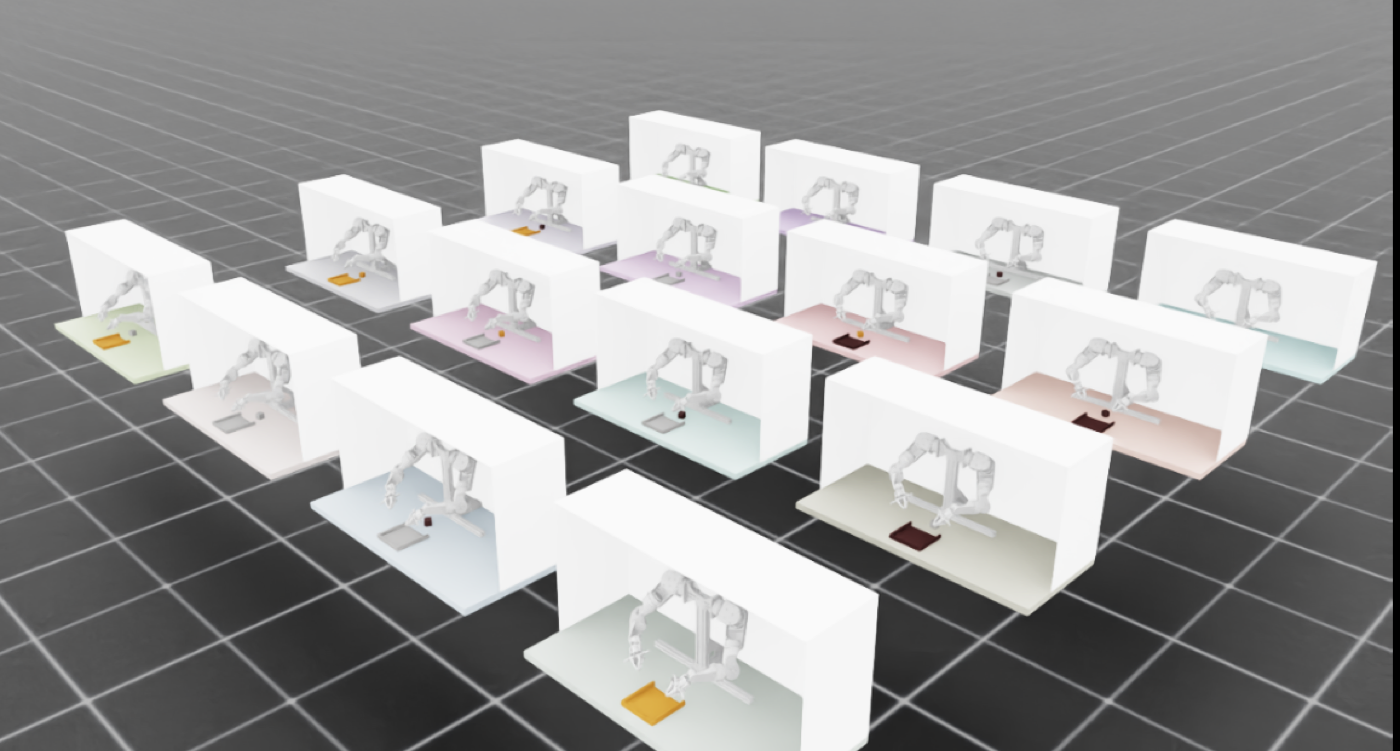
Parallelized manipulation task environments for RL training.
Geometric Fabrics PCA
Goal
Control a 21-DOF humanoid arm+hand using geometric fabrics — a control framework that's fast and stable without needing to solve an optimization problem every step.
The fingers have 15 joints, too many to command directly. So we use PCA to compress them to 7 numbers. PCA is trained on real human hand poses and learns the 7 directions that capture most of the variation in finger motion. You give it a 7-number command and it maps back to 15 joint angles via q_hand = W @ z + μ — just a change of coordinates. z is your 7D input, W maps it to joint space, and μ is the mean pose so that z = 0 gives you a natural resting hand.
Files
| File | Purpose |
|---|---|
compute_pca.py | Trains PCA from the HUST hand motion dataset, saves matrix/mean/bounds |
humanoid_hand_pose_fabric.py | Core controller — builds all the fabric layers (arm, hand, collision, joint limits) |
run_example.py | Runs the simulation loop at 60 Hz, renders optionally |
humanoid_hand_params.yaml | All the tunable params — gains, collision spheres, joint limits |
pca_matrix.npy, pca_mean.npy, pca_score_*.npy | Trained PCA files loaded at runtime |
FABRICS/ | NVIDIA geometric fabrics framework (submodule) |
How It Works
Every step, four layers each compute forces and sum them together:
- Arm attractor — holds the arm at a fixed default config (arm doesn't move)
- Finger attractor — takes the 7D PCA command, maps to 15 finger joints, pulls toward them
- Body repulsion — 21 spheres on the robot links push away from obstacles
- Joint limit repulsion — pushes back when joints get near their limits
All of that sums into qdd = -M⁻¹ f, which gets integrated to get the next joint state.